
How to Recognize an Investment Scam
Author: Adam Collins
In a Nutshell
- Verify every platform through official government databases like the SEC (Investor.gov), FCA Register, or ASIC before depositing any funds.
- Treat any "guaranteed return" or "risk-free" offer as an immediate confirmation of a fraudulent scheme.
- Never pay "taxes" or "release fees" to withdraw your own money; legitimate exchanges deduct fees from your existing balance.
- Ignore investment advice from strangers on WhatsApp, Telegram, or dating apps—these are the primary vectors for "pig butchering" scams.
Investment fraud accounts for billions of dollars in annual losses globally. From massive multi-billion dollar Ponzi scheme collapses to the daily "pig butchering" traps set on social media, the financial landscape is increasingly complex. You are likely reading this because a high-yield opportunity or a professional-looking "crypto expert" has crossed your path, and you need to know if the threat is real.
Learning to recognize these patterns is a survival requirement. Scammers use corporate branding and high-end web design to make their lies look like legitimate wealth-building tools. If you understand the mechanics of their deception, you can protect your life savings before a single dollar leaves your account.
How do I identify a "Pig Butchering" script?
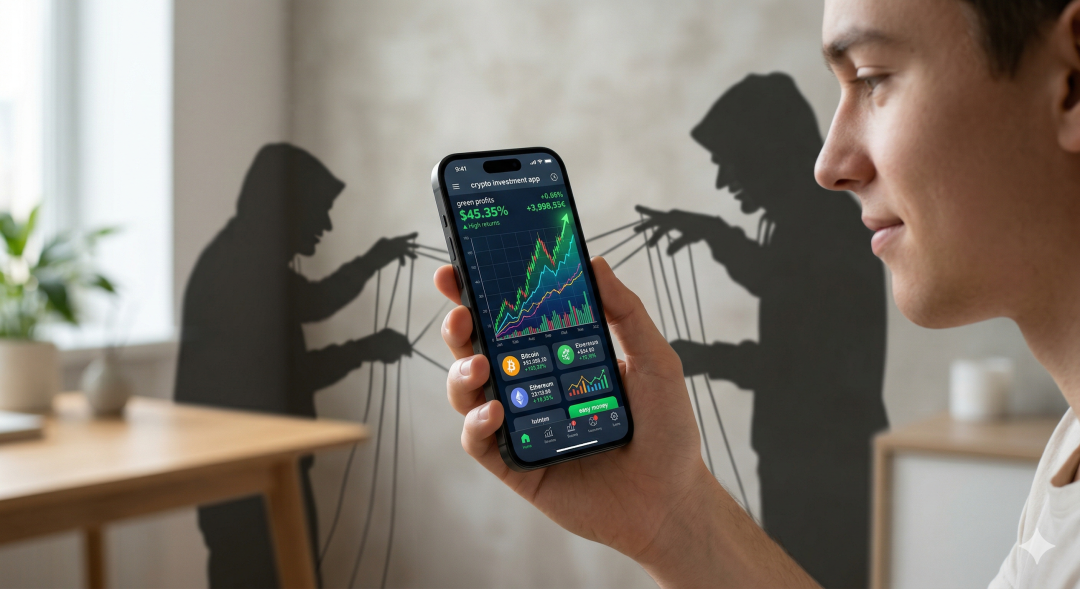
The pig butchering scam—named for "fattening" a victim with trust before the "slaughter"—is a psychological operation. It often begins with a "wrong number" text or an accidental LinkedIn connection that evolves into a months-long friendship or romance. Scammers now use advanced AI to manage these conversations, making them feel deeply personal.
The specific red flag is the "emotional anchoring" of the conversation to your dreams. They will ask what you would do with a specific sum of money, then show you doctored screenshots of their own fake profits to prove it is possible. If a stranger is more interested in your financial portfolio than your personality, you are the target.
What are the signs of a Ponzi scheme?
A Ponzi scheme relies on using money from new investors to pay "returns" to earlier investors. This creates a vertical price line on a chart that has no backing in economic reality.
- Lack of Transparency: If the company cannot explain how it generates profit beyond "proprietary algorithms," it is likely a shell.
- Recruitment Pressure: If you are promised a "referral bonus" for bringing in friends and family, the platform is likely a pyramid or Ponzi hybrid. In these schemes, you are the unpaid sales force for your own financial destruction.
How can I verify if a platform is regulated?
Legitimate financial institutions must register with national regulators to operate legally. Scammers cannot fake a listing in a government-managed database because these registries are hosted on secure, official domains.
- Check the URL: Registry sites are hosted on official domains like .gov or .org.uk.
- Beware of "Cloned Firms": Scammers often use the name and registration number of a real, regulated company. Always cross-reference the contact details on the regulator’s website with the details provided by the platform. If the email domains do not match exactly, you are dealing with an impostor.
Why should I reject "guaranteed" high returns?
In the real world, risk and return are inextricably linked. Scammers use the phrase "guaranteed returns" because it triggers a psychological response that shuts down critical thinking.
- The Math Test: No legitimate investment can guarantee a high daily or weekly percentage. To pay 1% daily, a firm would need to return over 3,700% annually—a feat no legitimate business has ever achieved consistently.
- Jargon Overload: Scammers use "tech-babble" like "decentralized liquidity mining" to make impossible returns sound like a technical feature rather than a lie.
Is the withdrawal process a trap?
The moment of truth in any fake platform is the withdrawal request. Legitimate platforms make money by charging a small percentage of your trade; they never ask for new money to access your existing funds.
THE RED LINE: If the platform demands a "capital gains tax," "insurance fee," or "security deposit" before you can withdraw, it is a scam. No regulated exchange functions this way. Once you pay the fee, the scammer will invent a new reason to demand even more.
Frequently Asked Questions (FAQ)
Can the FBI or a hacker get my money back from the blockchain?
No, blockchain transactions are mathematically irreversible, and anyone claiming they can "hack" it back is a recovery scammer.
Why does the platform show my balance is growing if it’s a scam?
The numbers you see on the screen are completely fabricated by the scammer to encourage you to deposit more money.
Is a video call with the "trader" proof that they are real?
No, scammers use real-time deepfake technology to impersonate trusted individuals or influencers during video calls.
Should I pay the "tax" the platform says I owe to withdraw?
No, legitimate exchanges always deduct fees from your account balance rather than asking for a separate payment.
Where do I report this if I have already sent money?
Immediately contact your bank’s fraud department and file a report with your national cybercrime agency, such as the FBI’s IC3 or Action Fraud.
If you cannot verify the person, the platform, and the profit source through an independent third party, the investment does not exist.
Adam Collins is a cybersecurity researcher at ScamAdviser who operates under a pseudonym for privacy and security. With over four years on the digital frontlines and 1,500+ days spent deconstructing thousands of fraud schemes, he specialises in translating complex threats into actionable advice. His mission: exposing red flags so you can navigate the web with confidence.
Report a Scam!

Have you fallen for a hoax, bought a fake product? Report the site and warn others!
Scam Categories
Help & Info
Top Safety Picks
Your Go-To Tools for Online SafetyDisclaimer: Some of the links here are affiliate links. If you click them and make a purchase, we may earn a commission at no extra cost to you.
- ScamAdviser App - iOS : Your personal scam detector, on the go! Check website safety, report scams, and get instant alerts. Available on iOS
- ScamAdviser App - Android : Your personal scam detector, on the go! Check website safety, report scams, and get instant alerts. Available on Android.
- NordVPN : NordVPN keeps your connection private and secure whether you are at home, traveling, or streaming from another country. It protects your data, blocks unwanted ads and trackers, and helps you access your paid subscriptions anywhere. Try it Today!
- Incogni : Incogni automatically removes your personal data from data brokers that trade in personal information online, helping reduce scam and identity theft risks without the hassle of manual opt-outs. Reclaim your privacy now!
Popular Stories
In a nutshell: A good VPN protects your privacy with strong encryption, a strict no-logs policy, and fast protocols like WireGuard. The best VPNs also offer wide server coverage, leak protection, and easy-to-use apps for all devices. For 2025, the top providers are NordVPN, ExpressVPN, Surfshark, Proton VPN, Private Internet Access, CyberGhost, and Mullvad—each excelling in speed, security, or value. In an age where every click is tracked, a Virtual Private Network (VPN) is no longer just a luxury—it's an essential tool for digital privacy and security. A VPN works by creating a secure, encrypted tunnel between your device and the internet, masking your real IP address and protecting your sensitive data from prying eyes. But with hundreds of providers out there, how do you sort the secure from the suspect? This guide breaks down the non-negotiable features of a quality VPN and highlights the 7 top-rated services for 2025. What to Look for in a Good VPN: The 4 Non-Negotiable Pillars 1. Ironclad Security Features Strong Encryption: AES-256, the gold standard. Secure Protocols: OpenVPN, WireGuard, NordLynx, Lightway. Avoid PPTP. Kill Switch: Ensures no accidental IP leaks. Leak Protection: Covers DNS, IPv6, and WebRTC. 2. Verified Privacy Practices No-Logs Policy: No activity or metadata tracking. Independent Audits: Verification by third parties. Safe Jurisdiction: Prefer countries outside the 5/9/14 Eyes alliances. 3. High-Speed Performance Fast Protocols: WireGuard and equivalents. Large Server Network: Less crowding, more reliable speeds. 4. Essential Usability Features Multi-Device Apps: Windows, Mac, iOS, Android, routers. Simultaneous Connections: One account, many devices. Unblocking Power: Netflix, Hulu, BBC
How to Protect Yourself and Your Family After a Data Breach When Your Data Falls Into the Wrong Hands Just received that terrifying notification? Or perhaps you've noticed suspicious activity in your accounts? Take a deep breath. A data breach, the unauthorized access or exposure of sensitive, protected, or confidential data, is a deeply unsettling event. It can plunge you into a world of worry, bringing risks from financial losses and identity theft to significant emotional distress and reputational damage. The numbers don't lie: according to a 2024 report, the number of data breach victim notices has grown by a staggering 211% year-over-year. This isn't just a distant threat; it's a stark reality many individuals face. This year alone, we've seen major organizations like Adidas and Qantas grapple with high-profile data breaches, affecting countless customers. This underscores a critical truth: nobody is untouchable. Subsequently, strategic action is the only way to minimize the risk and protect your future. This guide is your emergency action plan, designed to walk you through every crucial step—from confirming the breach to fortifying your digital life for the long term. Part 1: Confirming the Breach and Understanding the Damage The very first step is to answer the question definitively: Was my data compromised, and if so, how badly? Start with the basics: Check Official NotificationsReputable companies are legally obligated to inform you if your data was part of a breach. Look for official emails, letters, or public announcements. Check Verified Breach DatabasesPlatforms like HaveIBeenPwned help you see if