
We’ve Covered Online Scams for Years. These Are the Ones to Watch in 2026
Author: Adam Collins
Scams in 2026 are not louder or sloppier. They are calmer, cleaner, and far more convincing. Artificial intelligence is doing the heavy lifting, biometrics are becoming the main target, and scammers are exploiting the same routines people rely on every day. Fraud is no longer about obvious red flags. It is about blending in so well that nothing feels wrong until it is too late.
This is what the next generation of scams looks like, and why awareness matters more than ever.
In a Nutshell
- Scams in 2026 move beyond email and live in QR codes, physical mail, and fake interviews
- Romance and pig butchering scams are now powered by autonomous AI agents
- Job scams increasingly exist to harvest biometric data, not offer employment
- Deepfakes make video, voice, and selfies unreliable for verification
- Multi-channel scams jump across platforms to avoid detection
- Independent verification and scam-checking tools are no longer optional
Are Phishing Scams Evolving Beyond Email And Text Messages?
Are phishing scams evolving beyond email and text messages? Absolutely, but more importantly, phishing itself isn’t disappearing. We’ll still see familiar scams like fake toll road notices, Apple subscription alerts, and delivery messages. They’ll just keep showing up in more places.
Phishing has always followed convenience. In 2026, that means inboxes, messaging apps, websites, QR codes, and even physical mail. While QR code scams aren’t new, they remain effective, especially when paired with offline interactions or official-looking notices that lower suspicion.
The key takeaway is simple: phishing will persist because it works. The safest habit is to treat any unexpected request for payment or login with caution, regardless of how it reaches you. When in doubt, skip the link or scan and go directly to the official app or website instead.
Are Scammers Stealing Faces And Voices Through Fake Job Interviews?
Biometric data is becoming the new password, and scammers are collecting it aggressively. As banks and fintech platforms adopt Face ID and voice verification for high-risk actions, fraudsters are focusing on high-quality biometric harvesting.
Fake recruiters are inviting victims to professional-looking video interviews on custom platforms. The conversation feels normal, but the system is recording facial angles, blinking behavior, and voice samples. That data can later be used to bypass liveness checks and access financial accounts.
This is why job scams in 2026 are not always about fake salaries. Many exist purely to harvest identity data.
If a company insists on using an unfamiliar interview platform or requests identity verification before a real conversation, that is a serious warning sign.
How Will AI-Driven Romance And Pig Butchering Scams Change in 2026?
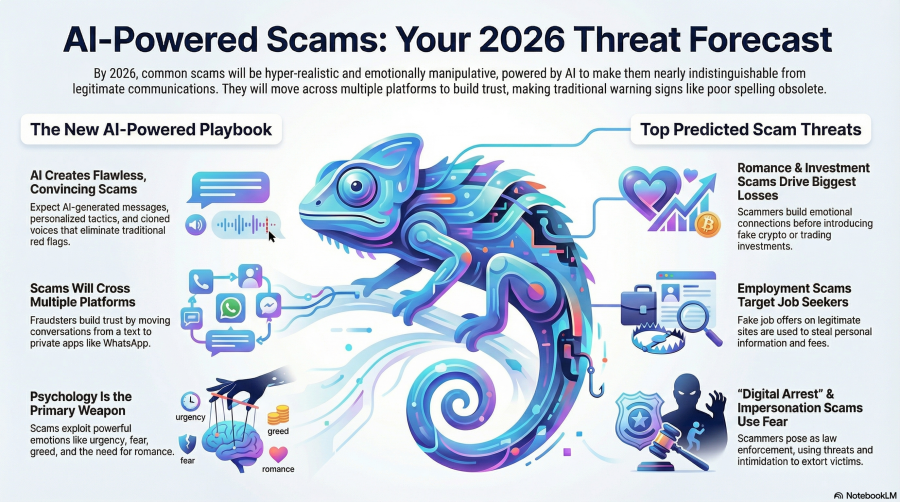
Romance scams and pig butchering scams are becoming fully automated. Instead of human scammers juggling conversations, autonomous AI agents now scrape social media in real time and build detailed profiles of potential victims.
These systems know when someone is lonely, grieving, newly wealthy, or emotionally vulnerable. Conversations feel natural because they are personalized using real information, not generic scripts. AI can maintain thousands of long-term conversations simultaneously and wait months before introducing an investment opportunity or financial request.
This scale makes pig butchering scams more dangerous than ever.
If an online relationship avoids real-world meetings, consistently experiences video call issues, or gradually steers conversations toward crypto or investments, assume manipulation rather than coincidence.
Why Are Scammers Jumping Between Platforms More Often?
Scammers in 2026 rarely stay on one platform long enough to be reported effectively. A scam may start with a wrong-number text, move to WhatsApp or Telegram, and end on a fake bank or cryptocurrency website.
This platform hopping is intentional. By fragmenting the interaction, scammers make it difficult for victims and platforms to reconstruct the full scam journey.
Anyone who pressures you to move conversations to private or encrypted apps quickly should be treated with caution.
Why Deepfakes Make Verification Harder Than Ever
In previous years, asking for a selfie or video call helped confirm identity. In 2026, that method no longer works reliably. AI-generated faces, voices, and live deepfakes are convincing enough to pass casual verification and even some automated checks.
This means trust must shift away from appearances and toward independent verification methods. Seeing is no longer believing.
Why The Scamadviser App is no Longer Optional
In a scam environment driven by speed and realism, independent verification tools are critical. The ScamAdviser app helps identify suspicious websites, detect risky domains, and flag known scam patterns before damage is done.
Instead of relying on gut feeling or last-minute Google searches, the app allows users to check links, businesses, and offers in real time. In a world where scams look professional and familiar, having a trusted second opinion can be the difference between staying safe and losing money.
In 2026, protection is not about reacting after the fact. It is about checking first.
Frequently Asked Questions
What is a pig butchering scam?
A pig butchering scam is a long-term fraud where scammers build trust through relationships before convincing victims to invest or send money, often using fake trading platforms.
Are romance scams really run by AI now?
Increasingly, yes. Many conversations are handled by AI systems that personalize messages, timing, and emotional responses at scale.
How can I spot a fake job interview?
Be cautious of unfamiliar platforms, rushed hiring processes, and requests for video verification or biometric data early in the process.
Are QR codes safe to use?
QR codes themselves are not dangerous, but unverified codes can lead to phishing websites and payment scams.
How can I avoid scams in 2026?
Slow down, verify independently, avoid urgency, limit data sharing, and use scam detection tools like ScamAdviser before acting.
Scams in 2026 are designed to feel normal. The strongest defense is not technical expertise, but a habit of questioning convenience and verifying everything independently.
Report a Scam!

Have you fallen for a hoax, bought a fake product? Report the site and warn others!
Scam Categories
Help & Info
Top Safety Picks
Your Go-To Tools for Online SafetyDisclaimer: Some of the links here are affiliate links. If you click them and make a purchase, we may earn a commission at no extra cost to you.
- ScamAdviser App - iOS : Your personal scam detector, on the go! Check website safety, report scams, and get instant alerts. Available on iOS
- ScamAdviser App - Android : Your personal scam detector, on the go! Check website safety, report scams, and get instant alerts. Available on Android.
- NordVPN : NordVPN keeps your connection private and secure whether you are at home, traveling, or streaming from another country. It protects your data, blocks unwanted ads and trackers, and helps you access your paid subscriptions anywhere. Try it Today!
- Incogni : Incogni automatically removes your personal data from data brokers that trade in personal information online, helping reduce scam and identity theft risks without the hassle of manual opt-outs. Reclaim your privacy now!
Popular Stories
In a nutshell: A good VPN protects your privacy with strong encryption, a strict no-logs policy, and fast protocols like WireGuard. The best VPNs also offer wide server coverage, leak protection, and easy-to-use apps for all devices. For 2025, the top providers are NordVPN, ExpressVPN, Surfshark, Proton VPN, Private Internet Access, CyberGhost, and Mullvad—each excelling in speed, security, or value. In an age where every click is tracked, a Virtual Private Network (VPN) is no longer just a luxury—it's an essential tool for digital privacy and security. A VPN works by creating a secure, encrypted tunnel between your device and the internet, masking your real IP address and protecting your sensitive data from prying eyes. But with hundreds of providers out there, how do you sort the secure from the suspect? This guide breaks down the non-negotiable features of a quality VPN and highlights the 7 top-rated services for 2025. What to Look for in a Good VPN: The 4 Non-Negotiable Pillars 1. Ironclad Security Features Strong Encryption: AES-256, the gold standard. Secure Protocols: OpenVPN, WireGuard, NordLynx, Lightway. Avoid PPTP. Kill Switch: Ensures no accidental IP leaks. Leak Protection: Covers DNS, IPv6, and WebRTC. 2. Verified Privacy Practices No-Logs Policy: No activity or metadata tracking. Independent Audits: Verification by third parties. Safe Jurisdiction: Prefer countries outside the 5/9/14 Eyes alliances. 3. High-Speed Performance Fast Protocols: WireGuard and equivalents. Large Server Network: Less crowding, more reliable speeds. 4. Essential Usability Features Multi-Device Apps: Windows, Mac, iOS, Android, routers. Simultaneous Connections: One account, many devices. Unblocking Power: Netflix, Hulu, BBC
How to Protect Yourself and Your Family After a Data Breach When Your Data Falls Into the Wrong Hands Just received that terrifying notification? Or perhaps you've noticed suspicious activity in your accounts? Take a deep breath. A data breach, the unauthorized access or exposure of sensitive, protected, or confidential data, is a deeply unsettling event. It can plunge you into a world of worry, bringing risks from financial losses and identity theft to significant emotional distress and reputational damage. The numbers don't lie: according to a 2024 report, the number of data breach victim notices has grown by a staggering 211% year-over-year. This isn't just a distant threat; it's a stark reality many individuals face. This year alone, we've seen major organizations like Adidas and Qantas grapple with high-profile data breaches, affecting countless customers. This underscores a critical truth: nobody is untouchable. Subsequently, strategic action is the only way to minimize the risk and protect your future. This guide is your emergency action plan, designed to walk you through every crucial step—from confirming the breach to fortifying your digital life for the long term. Part 1: Confirming the Breach and Understanding the Damage The very first step is to answer the question definitively: Was my data compromised, and if so, how badly? Start with the basics: Check Official NotificationsReputable companies are legally obligated to inform you if your data was part of a breach. Look for official emails, letters, or public announcements. Check Verified Breach DatabasesPlatforms like HaveIBeenPwned help you see if