
$100 McDonald’s Gift Card Offer at Sites Like McGiftClaim.com: Scam or Legit?
Author: De-Reviews.com Team
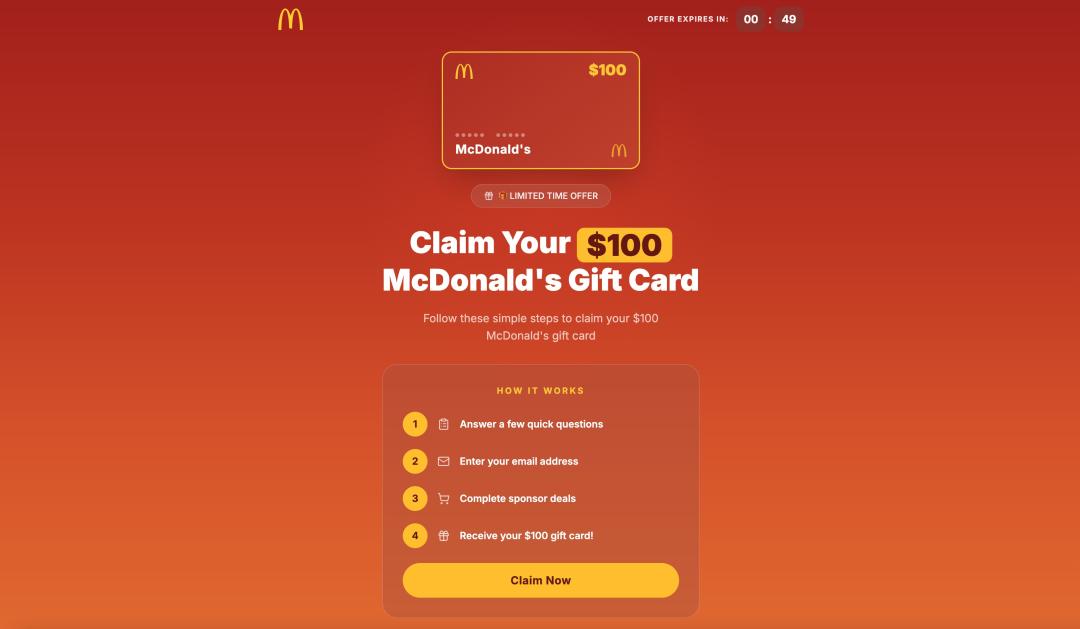
In recent months, online promotions claiming to offer a $100 McDonald’s Gift Card have been appearing on social media, email campaigns, and pop-up ads. One of the websites promoting this offer is McGiftClaim.com, which claims users can receive a McDonald’s gift card after completing a short survey or filling in some basic information.
While the offer may sound exciting, it is important to examine whether such promotions are legitimate. Understanding how these gift card promotions work and how to identify legitimate sources can help you avoid wasting time or risking your personal information.
What Is the $100 McDonald’s Gift Card Promotion?
The promotion on sites like McGiftClaim.com usually asks participants to answer a few questions, complete surveys, or share personal details in exchange for a supposedly free $100 McDonald’s Gift Card. Some versions of the offer even include instructions that require users to make small payments or provide payment details to verify eligibility.
It is important to remember that McDonald’s does not authorize any gift card giveaways through random online surveys or third party websites. Official promotions are always announced on the McDonald’s website, app, or verified social media channels. If you encounter an offer elsewhere, it should be approached with caution.
How Sites Like McGiftClaim.com Appears Online?
The websites like McGiftClaim.com presents themselves as legitimate platforms offering McDonald’s gift cards, but there are several concerns:
- They are not linked to any official McDonald’s website or verified social media account.
- Users are directed through multiple pages, often with confusing instructions.
- Requests for personal information are common, which can be risky if the site is not secure.
Independent review platform De-Reviews has reviewed McGiftClaim.com and assigned a TrustScore of only 19% out of 100%, indicating a very low level of confidence in the site’s reliability. This score reflects multiple risk factors such as website age, ownership details, and user reports.
Key Takeaways to Avoid Risky Offers:
When evaluating any online gift card promotion, there are several key points to keep in mind, such as:
No Surveys or Fees:
Legitimate gift card offers do not ask you to complete surveys, pay a fee, or provide financial information before receiving a reward.
Check Sources:
Only trust promotions that appear directly on McDonald’s official website or authorized partners. Avoid unfamiliar websites or links sent through social media.
Report Concerns:
If you have already shared personal information or made a payment in relation to such an offer, contact the Federal Trade Commission (FTC) immediately. Prompt reporting can help prevent further misuse of your details.
Understanding How Legitimate McDonald’s Gift Cards Work:
A $100 McDonald's Gift Card (often called an Arch Card) can be purchased for personal use, bulk orders, or as gifts directly from McDonald's restaurants, or via retailers like Target. These cards are reloadable, valid at participating locations, and can be used for in-store, drive-thru, or sometimes app purchases.
Here’s What to Know About Authentic McDonald’s Gift Cards:
- They are reloadable and can be used multiple times until the balance runs out.
- They are valid at participating McDonald’s restaurants nationwide.
- They are intended for personal use, gifting, or bulk orders, but always through verified channels.
By purchasing through official sources, you can enjoy the gift cards without risking personal data or falling into misleading promotions.
Why Some Promotions Are Risky?
Websites claiming to provide free McDonald’s Gift Cards through surveys or pop-ups are often designed to collect user information or encourage payments under false pretenses. These sites may appear convincing with logos, professional layouts, and user friendly interfaces, but they do not provide gift cards legitimately.
Even without asking for money, sharing personal details such as your name, email, phone number, or payment info can be risky. Such information can be used for marketing, spam, or even identity theft.
Final Thoughts:
While the idea of receiving a $100 McDonald’s Gift Card for minimal effort is tempting, it is crucial to approach online offers carefully. The safest way to obtain McDonald’s Gift Cards is through official McDonald’s restaurants or authorized retailers.
Websites like McGiftClaim.com, which claim to provide free gift cards via surveys, should be treated with caution. Checking independent review sources can provide additional insight into potential risks.
Always remember: If an offer sounds too good to be true, it usually is. Protect your personal information, and stick to verified channels when purchasing or receiving gift cards.
Disclaimer: This article has been written by a Scam Fighter Contributor. If you believe the article above contains inaccuracies or needs to include relevant information, please contact ScamAdviser.com using this form.
Report a Scam!

Have you fallen for a hoax, bought a fake product? Report the site and warn others!
Scam Categories
Help & Info
Top Safety Picks
Your Go-To Tools for Online SafetyDisclaimer: Some of the links here are affiliate links. If you click them and make a purchase, we may earn a commission at no extra cost to you.
- ScamAdviser App - iOS : Your personal scam detector, on the go! Check website safety, report scams, and get instant alerts. Available on iOS
- ScamAdviser App - Android : Your personal scam detector, on the go! Check website safety, report scams, and get instant alerts. Available on Android.
- NordVPN : NordVPN keeps your connection private and secure whether you are at home, traveling, or streaming from another country. It protects your data, blocks unwanted ads and trackers, and helps you access your paid subscriptions anywhere. Try it Today!
- Incogni : Incogni automatically removes your personal data from data brokers that trade in personal information online, helping reduce scam and identity theft risks without the hassle of manual opt-outs. Reclaim your privacy now!
Popular Stories
In a nutshell: A good VPN protects your privacy with strong encryption, a strict no-logs policy, and fast protocols like WireGuard. The best VPNs also offer wide server coverage, leak protection, and easy-to-use apps for all devices. For 2025, the top providers are NordVPN, ExpressVPN, Surfshark, Proton VPN, Private Internet Access, CyberGhost, and Mullvad—each excelling in speed, security, or value. In an age where every click is tracked, a Virtual Private Network (VPN) is no longer just a luxury—it's an essential tool for digital privacy and security. A VPN works by creating a secure, encrypted tunnel between your device and the internet, masking your real IP address and protecting your sensitive data from prying eyes. But with hundreds of providers out there, how do you sort the secure from the suspect? This guide breaks down the non-negotiable features of a quality VPN and highlights the 7 top-rated services for 2025. What to Look for in a Good VPN: The 4 Non-Negotiable Pillars 1. Ironclad Security Features Strong Encryption: AES-256, the gold standard. Secure Protocols: OpenVPN, WireGuard, NordLynx, Lightway. Avoid PPTP. Kill Switch: Ensures no accidental IP leaks. Leak Protection: Covers DNS, IPv6, and WebRTC. 2. Verified Privacy Practices No-Logs Policy: No activity or metadata tracking. Independent Audits: Verification by third parties. Safe Jurisdiction: Prefer countries outside the 5/9/14 Eyes alliances. 3. High-Speed Performance Fast Protocols: WireGuard and equivalents. Large Server Network: Less crowding, more reliable speeds. 4. Essential Usability Features Multi-Device Apps: Windows, Mac, iOS, Android, routers. Simultaneous Connections: One account, many devices. Unblocking Power: Netflix, Hulu, BBC
How to Protect Yourself and Your Family After a Data Breach When Your Data Falls Into the Wrong Hands Just received that terrifying notification? Or perhaps you've noticed suspicious activity in your accounts? Take a deep breath. A data breach, the unauthorized access or exposure of sensitive, protected, or confidential data, is a deeply unsettling event. It can plunge you into a world of worry, bringing risks from financial losses and identity theft to significant emotional distress and reputational damage. The numbers don't lie: according to a 2024 report, the number of data breach victim notices has grown by a staggering 211% year-over-year. This isn't just a distant threat; it's a stark reality many individuals face. This year alone, we've seen major organizations like Adidas and Qantas grapple with high-profile data breaches, affecting countless customers. This underscores a critical truth: nobody is untouchable. Subsequently, strategic action is the only way to minimize the risk and protect your future. This guide is your emergency action plan, designed to walk you through every crucial step—from confirming the breach to fortifying your digital life for the long term. Part 1: Confirming the Breach and Understanding the Damage The very first step is to answer the question definitively: Was my data compromised, and if so, how badly? Start with the basics: Check Official NotificationsReputable companies are legally obligated to inform you if your data was part of a breach. Look for official emails, letters, or public announcements. Check Verified Breach DatabasesPlatforms like HaveIBeenPwned help you see if